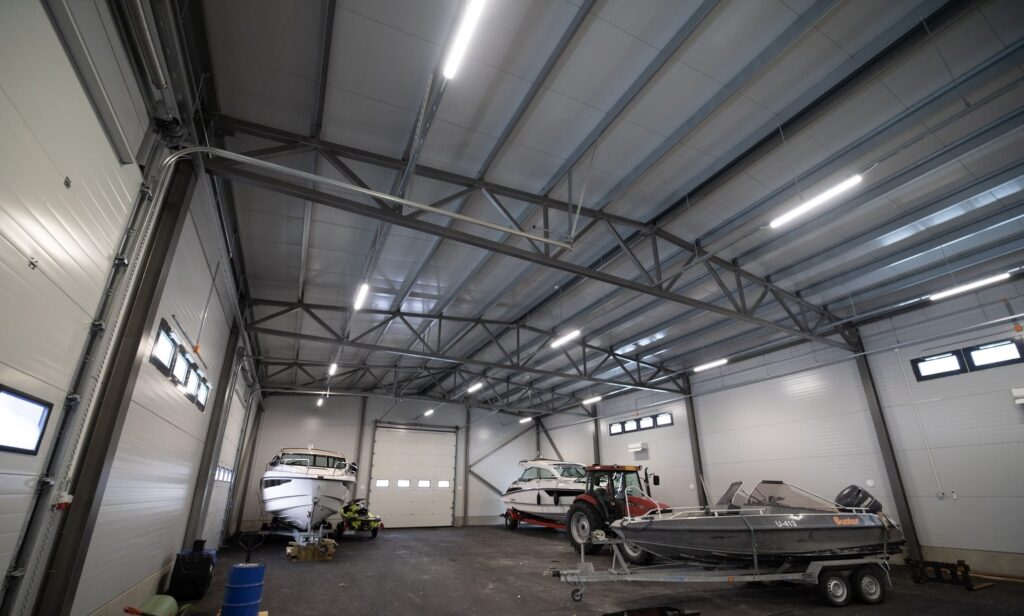
A machine hall is a versatile building that provides protection and storage space for various machines, vehicles, and equipment. Whether it’s farm tractors, contracting equipment, or industrial machinery, a machine hall brings order, protection, and functionality to business operations. This article examines the importance of machine hall design, structures, and materials, and provides practical tips for implementing a functional hall.
Intended Use Determines Hall Dimensions
Machine hall design begins with defining the intended use. Is the hall intended solely for storage or also for maintenance work? Is heating, lighting, or separate spaces required?
In agriculture, a machine hall can serve as a multipurpose space for storing tractors, trailers, and work machines, as well as servicing them. In industry, the hall can function as part of the production chain or logistics.
The interior height of the hall is an important factor, especially when moving tall equipment or using lifting devices.
Machine Hall Applications:
- Storage of tractors and work machines
- Maintenance of forestry equipment
- Protection of trailers and vehicles
- Warehousing and Logistics
Important considerations in dimensioning:
- Size of vehicles and equipment
- Drivability and door dimensions
- Potential lifting equipment or maintenance space
- Future expansion needs
Structures and Materials Provide Decades of Durability
Machine hall structures must withstand varying weather conditions, loads, and use. The most commonly used materials are steel and wood, but steel structures offer the best load-bearing capacity and longevity, especially in large halls.
Steel provides structural strength that enables spacious interiors without load-bearing partition walls, thanks to large span capabilities.
Wall structures can be either prefabricated or built on-site, depending on budget and schedule.
Machine hall roof and wall cladding typically uses steel sheet metal coated to withstand Finland’s varying weather conditions. Multiple profiles and colors are available, allowing the hall’s appearance to be matched to the environment or company image.
For example, Weckman’s W-20 and W-45 profiles offer excellent load-bearing capacity and a stylish appearance. An insulation layer can be added to wall structures if the hall is used year-round or as a temperature-controlled space.
Weckman Steel’s range includes high-quality steel profiles and roofing materials that are excellently suited for machine hall construction. For example:
- Standing seam roofs and profile sheets provide tight and durable roof protection.
- Steel-framed elements enable fast and modular construction.
- Weather-protected wall elements improve the hall’s energy efficiency and appearance.
Roof Shape and Rainwater Management
The machine hall roof shape affects both appearance and functionality. The most common options are gable roof and shed roof. A gable roof is particularly suitable for snowy areas, as it facilitates snow sliding off the roof. A shed roof is more economical and simpler to implement.
Rainwater management is an important part of structural durability. Well-designed eaves, gutters, and water drainage prevent moisture from entering the structures and extend the hall’s service life.
Foundations and Ground Base
Machine hall foundations must be designed according to the soil conditions. Heavy equipment requires a load-bearing and level base that will not settle or crack. Common foundation methods include:
- Concrete footing foundation
- Reinforced concrete slab under the entire hall
- Beam foundation combined with crushed stone base
A good ground base and drainage prevent moisture from rising into the structures and improve the hall’s operating conditions.
Machine Hall Accessories and Functionality
A functional machine hall is not just a roof over equipment, but a complete solution that serves the business. Important accessories include:
- Electrical installation and lighting
- Heating solutions (e.g., infrared heaters or air-source heat pumps)
- Security systems (cameras, alarms)
- Shelving systems and tool walls
These enable the hall to become an efficient workspace that supports maintenance, storage, and equipment management.
Weckman Machine Hall Is an Investment in Your Business
A well-designed and constructed machine hall is a long-term investment that improves equipment service life, increases safety, and brings efficiency to daily operations. Whether it’s a farm, contracting company, or industrial facility, a Weckman machine hall offers a flexible and durable solution for equipment storage and maintenance. A machine hall that serves its user for decades.

 Suomi
Suomi