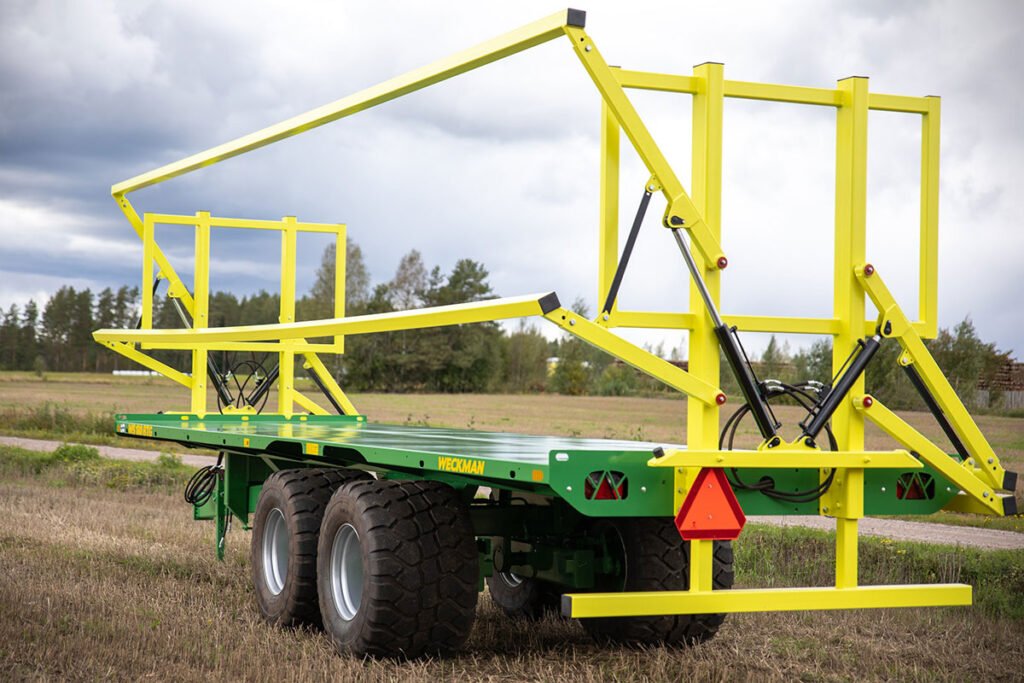
The production of the redesigned Weckman trailer range has been reconsidered from design through procurement, production, and delivery. The trailers use increasingly more raw materials produced with environmentally friendly methods. CO2 emissions from trailer steel production have decreased by 1.5 million kilograms annually since the launch.
“Changes in the design and manufacturing of the trailers have reduced emissions during production, raw material consumption, and the environmental impact during use. With these changes, we also meet the requirements of EU directives regarding agricultural machinery design and machine safety*,” says Janne Hiironen, Product Line Manager for Weckman trailers.
More Ecological Trailer Design and Use
The new trailer range is manufactured using as little steel as possible, and the trailers are tested to ensure they withstand all intended uses for their load capacity class. “We have designed the trailer frames and platforms to use approximately 40% fewer individual steel parts. This change streamlines the entire production chain and increases environmental friendliness by reducing the energy consumption of the machines used in manufacturing,” says Hiironen.
Trailer users have not been forgotten in the redesign. “A trailer with the same load capacity can now carry larger payloads, which means up to 20% less transport driving and frees up time for other work. Every percent that can be added to the load reduces fuel consumption and CO2 emissions by one percent,” Hiironen explains.
“The trailers are, on average, 10% lighter, which reduces the fuel consumption of the tractor pulling them by 5%. Every 1,000 liters of unused fuel will reduce CO2 emissions by 3,000 kg,” he continues.
Sustainable Trailer Manufacturing Reduces Logistics Carbon Footprint
The new trailers are manufactured 99% by robotic welding, which makes welding highly repeatable, speeds up the manufacturing process, eliminates waste, and consumes less energy. Manual welding has been almost entirely eliminated.
The environmental impact of logistics is also lower than before. All five load capacity class trailers use primarily the same parts, the number of part numbers has dropped by half, and the overall weights of the trailers are lighter.
“We can produce more trailers with a smaller amount of raw material: we can order steel in larger loads, reduce the number of deliveries, and thereby lower the emissions generated by material transport. Utilizing the same parts also simplifies spare parts needs and maintenance, and improves our service,” Hiironen says.
Halving the number of item titles and moving to robotic welding have streamlined manufacturing and reduced internal logistics. “Less time and fewer chemicals are now required for handling and moving the parts used in manufacturing. This reduces the carbon footprint of our internal logistics and shortens our lead times: we can now manufacture four trailers in the time previously required for one,” Hiironen says.
Responsible Trailer Manufacturing from Vierumäki
Robotic welding makes every weld seam precisely traceable by registering the seam data in the machine. “Our raw materials are also fully traceable. Our suppliers produce consistent quality material, and we receive very few complaints. However, if something were to happen, we can investigate the causes very precisely and react to them,” Hiironen states.
The surface treatment of the trailers will transition to a new technology during 2022. The process will become significantly more environmentally friendly, starting from the raw materials – without compromising on high quality. “We will share more about this next year; we are currently testing the durability of the new paints,” Hiironen states.
“In the future, we will also offer top-tier Weckman products made from recycled materials. In 2030, we will manufacture Weckman trailers using entirely fossil-free steel,” he continues regarding future plans.
Even after all the updates, the principle of Weckman trailer production remains the same. “The quality of our products has always been ‘the best you can get’ – we will not compromise on this. A Weckman trailer lasts for decades in use and does not need to be repaired or replaced. This, if anything, is ecological sustainability,” Hiironen concludes.
*SFS-EN 1853:2017 + AC:2019 and SFS-EN ISO 12100
How the redesigned Weckman trailers save the environment:
10% lighter trailer → 5% lower fuel consumption
20% fewer haul trips thanks to larger payloads
40% fewer steel parts in trailer manufacturing
1.5 million kilograms less CO2 emissions annually in steel production

 Suomi
Suomi Svenska